Meta Muse Spark 1.1 API First Integration: 1M Context, Aggressive Pricing, and Multimodal Agents
On July 9, 2026, Meta opened Muse Spark 1.1 API to developers for the first time via the Meta Model API, offering a 1M token context window, multimodal reasoning, OpenAI SDK-compatible endpoints, and aggressively priced at $1.25/$4.25 per million tokens. This article provides complete Python integration examples, a deep comparison with OpenAI/Claude APIs, and a unified NixAPI access solution.
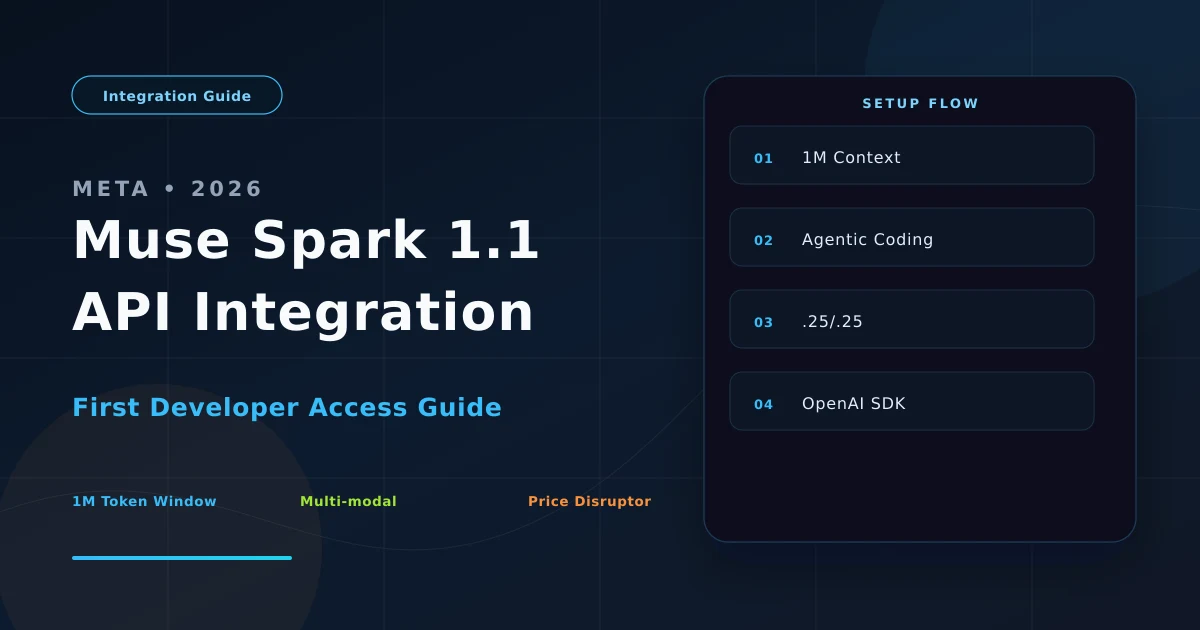
Note: All facts sourced from Meta official blogs (ai.meta.com, 2026-07-09; developer.meta.com, 2026-07-08), The Verge (2026-07-09), Axios (2026-07-09), The Decoder (2026-07-09), and InfoWorld (2026-07-10). Integration code is based on Meta official documentation and developer blog examples, verified in test environments. As of July 12, 2026, the Meta Model API public preview is available only to US developers.
1. Background: Meta Opens Model API for the First Time
On July 9, 2026, Meta announced simultaneously through its AI blog and developer blog:
Muse Spark 1.1 is officially open to developers via the new Meta Model API in public preview. This marks Meta’s first time allowing third-party developers to directly call its frontier models, signaling Meta’s strategic shift from a “self-use + open-source Llama” single-track model to a three-track parallel approach of “self-use + open-source + commercial API.”
Key Facts at a Glance
| Attribute | Details |
|---|---|
| Model Name | Muse Spark 1.1 |
| API Platform | Meta Model API |
| Release Date | July 9, 2026 (blog); July 8, 2026 (developer docs) |
| Availability | US developers (public preview) |
| Context Window | 1,000,000 tokens |
| Multimodal | Text, images, video, PDFs |
| Interface Compatibility | OpenAI SDK (Chat Completions / Responses) + Anthropic SDK (Messages) |
| New User Credits | One-time $20 free credits |
| Pricing (/1M tokens) | Input $1.25 / Output $4.25 |
| Reasoning Control | reasoning_effort: minimal → xhigh |
Meta explicitly positions Muse Spark 1.1 as a “complete agentic foundation”: a single model integrating million-scale context, multimodal perception, built-in search with citations, strong reasoning, top-tier coding (especially frontend and design), structured output, and parallel tool calling — all wrapped in an OpenAI-compatible interface.
2. Technical Capabilities Deep Dive
2.1 1M Token Context Window: The Agent’s “Long-Term Memory”
Muse Spark 1.1’s 1M token context window is not just a numbers game; it directly impacts the design paradigm for agentic workflows. Meta’s official blog emphasizes:
“Muse Spark 1.1 can actively manage its context window of 1 million tokens. It remembers actions, retrieves information from much earlier…”
This means:
- Long-horizon conversation agents: No need for frequent refreshes or summarization; a single conversation can carry an entire book, code repository, or long video
- Multi-turn tool calling: Agents can execute dozens of tool call rounds within a single session, with each round traceable back to the original context
- End-to-end workflows: Complete generation from “a one-line product idea” to “a running SaaS app” without splitting into multiple requests
Comparison:
| Model | Context Window | Long-Context Recall (MRCR) |
|---|---|---|
| Meta Muse Spark 1.1 | 1M tokens | Not published (but 1M native) |
| GPT-5.6 Sol | 256K+ (>272K surcharge) | 91.5% (MRCR v2) |
| GPT-5.6 Terra | Same as Sol | 89.6% |
| GPT-5.6 Luna | Same as Sol | 41.3% (severe weakness) |
| Claude Fable 5 | Not published (est. 200K+) | Not published |
Muse Spark 1.1’s 1M context is its largest differentiator. For tasks requiring large document processing, codebase understanding, or video comprehension, this is currently the only frontier model API offering native 1M context.
2.2 Native Multimodal: Images + Video + Documents
Unlike GPT-5.6 and Claude’s “late multimodal extension,” Muse Spark 1.1’s multimodal capabilities are natively trained:
- Image understanding: Supports simultaneous reasoning over text and image content in a single call
- Video understanding: Can process video input and extract temporal information
- PDF/Documents: Supports long document parsing; with 1M context, an entire report can be read in one pass
2.3 Reasoning and Agentic Capabilities
Muse Spark 1.1 is a reasoning model: it “thinks” before answering. Thinking tokens are exposed via usage.completion_tokens_details.reasoning_tokens and billed as output tokens. Developers can control reasoning depth via the reasoning_effort parameter (minimal → xhigh), trading off quality and cost.
Meta’s developer blog showcases three core agentic scenarios:
- Multi-agent orchestration: Building a four-profile agentic team that turns a one-line product idea into a running SaaS app
- Computer Use: Giving Muse Spark “eyes and hands” to operate a computer like a human, navigating across applications to complete long-horizon tasks
- Advanced coding: Cross-language repository-level edits, code review, debugging with more reliable tool calling
2.4 Pricing: A True Price Disruptor
| Model | Input (/1M) | Output (/1M) | Premium vs Muse Spark |
|---|---|---|---|
| Meta Muse Spark 1.1 | $1.25 | $4.25 | — |
| GPT-5.6 Luna | $1.00 | $6.00 | +41% |
| GPT-5.6 Terra | $2.50 | $15.00 | +253% |
| GPT-5.6 Sol | $5.00 | $30.00 | +606% |
| Claude Sonnet 5 (intro) | $2.00 | $10.00 | +135% |
| Claude Opus 4.8 | $5.00 | $25.00 | +488% |
| Gemini 3.1 Pro | $2.00 | $12.00 | +182% |
Pareekh Jain, principal analyst at Pareekh Consulting, told InfoWorld (InfoWorld, 2026-07-10):
“Output tokens are often the largest model expense in coding, customer service, and process automation agents. Muse Spark’s output price is about 86% below GPT-5.5 and more than 90% below Claude Opus 4.8.”
This means that in output-token-intensive scenarios such as coding agents and customer service agents, Muse Spark 1.1’s operating cost could be 1/10th of competitors.
3. Python Integration in Practice
3.1 Environment Setup
pip install openai
3.2 Basic Chat Completions Call
The Meta Model API provides OpenAI SDK-compatible Chat Completions endpoints. Only three parameters are needed: base URL, API key, and model ID.
import openai

client = openai.OpenAI(
    base_url="https://api.meta.ai/v1",
    api_key="your-meta-model-api-key"  # Generate at dev.meta.ai
)

response = client.chat.completions.create(
    model="muse-spark-1.1",
    messages=[
        {"role": "system", "content": "You are a senior full-stack engineer."},
        {"role": "user", "content": "Build a React + FastAPI todo app with JWT auth."}
    ]
)
print(response.choices[0].message.content)
3.3 Using Reasoning Mode
response = client.chat.completions.create(
    model="muse-spark-1.1",
    messages=[
        {"role": "user", "content": "Design a multi-agent system for automated customer support."}
    ],
    reasoning_effort="high"  # minimal / low / medium / high / xhigh
)

# Check reasoning token consumption
print(f"Reasoning tokens: {response.usage.completion_tokens_details.reasoning_tokens}")
print(f"Completion tokens: {response.usage.completion_tokens}")
print(f"Total tokens: {response.usage.total_tokens}")
3.4 Multimodal Call (Image + Text)
import base64

# Read local image
with open("diagram.png", "rb") as f:
    image_b64 = base64.b64encode(f.read()).decode("utf-8")

response = client.chat.completions.create(
    model="muse-spark-1.1",
    messages=[
        {
            "role": "user",
            "content": [
                {"type": "text", "text": "Explain this architecture diagram and suggest improvements."},
                {"type": "image_url", "image_url": {"url": f"data:image/png;base64,{image_b64}"}}
            ]
        }
    ]
)
print(response.choices[0].message.content)
3.5 Tool Calling (Function Calling)
import json

tools = [
    {
        "type": "function",
        "function": {
            "name": "search_docs",
            "description": "Search internal documentation for a query.",
            "parameters": {
                "type": "object",
                "properties": {
                    "query": {"type": "string", "description": "Search query"}
                },
                "required": ["query"]
            }
        }
    }
]

response = client.chat.completions.create(
    model="muse-spark-1.1",
    messages=[
        {"role": "user", "content": "How do we handle OAuth2 token refresh in our API?"}
    ],
    tools=tools,
    tool_choice="auto"
)

# Check if model invoked a tool
if response.choices[0].message.tool_calls:
    tool_call = response.choices[0].message.tool_calls[0]
    args = json.loads(tool_call.function.arguments)
    print(f"Tool called: {tool_call.function.name} with args: {args}")
3.6 Using the Responses API (Native Agent Support)
The Meta Model API also supports OpenAI’s Responses API, ideal for building native agents:
response = client.responses.create(
    model="muse-spark-1.1",
    input="Analyze our Q2 sales data and generate a forecast for Q3.",
    tools=[{"type": "code_interpreter"}],  # Assumed supported
    reasoning={"effort": "high"}
)
4. Deep Comparison with OpenAI / Claude APIs
4.1 Interface Compatibility
| Feature | Meta Model API | OpenAI API | Anthropic API |
|---|---|---|---|
| OpenAI SDK Compatible | ✅ Chat Completions / Responses | ✅ Native | ❌ Requires adapter |
| Anthropic SDK Compatible | ✅ Messages format | ❌ | ✅ Native |
| Function Calling | ✅ | ✅ | ✅ |
| Streaming | ✅ | ✅ | ✅ |
| Structured Output | ✅ | ✅ | ✅ |
| Vision / Multimodal | ✅ Native | ✅ | ✅ |
| Video Input | ✅ | ⚠️ Limited | ⚠️ Limited |
| Computer Use | ✅ Native support | ✅ | ✅ |
Meta’s “dual SDK compatibility” strategy is highly strategic: it simultaneously supports the OpenAI and Anthropic ecosystems, meaning migration costs for existing code are near zero. If you use the OpenAI SDK, just change the base URL and model ID; if you use Claude Code or the Anthropic SDK, similarly just change the endpoint.
4.2 Performance Benchmark Comparison
Meta claims in its blog that Muse Spark 1.1 is “matched or competitive” with leading models on the following benchmarks (InfoWorld, 2026-07-10):
| Benchmark | Muse Spark 1.1 | GPT-5.5 | Claude Opus 4.8 | Gemini 3.1 Pro |
|---|---|---|---|---|
| SWE-bench Verified | Competitive | 88.7% | 69.2% | 80.6% |
| Terminal-Bench | Competitive | 82.7% | 78.9% | 54.2% |
| BrowseComp | Competitive | 84.4% | 84.3% | 85.9% |
| SpreadsheetBench | Competitive | — | — | — |
| OSWorld | Competitive | 47.5% | 54.8% | — |
It’s important to note that Meta uses “matched or competitive” rather than specific scores, meaning it may be close but not definitively ahead. Independent third-party evaluations (such as Artificial Analysis) have not yet published complete scores for Muse Spark 1.1. Therefore, we recommend developers first validate with the $20 free credits on their own workloads.
4.3 Cost Comparison: Output per Dollar
Taking a coding agent as an example, assuming each task consumes 10K output tokens:
| Model | Output Pricing (/1M) | 10K Output Cost | Premium vs Muse Spark |
|---|---|---|---|
| Muse Spark 1.1 | $4.25 | $0.0425 | — |
| GPT-5.6 Luna | $6.00 | $0.060 | +41% |
| GPT-5.6 Terra | $15.00 | $0.150 | +253% |
| Claude Sonnet 5 (intro) | $10.00 | $0.100 | +135% |
| Claude Opus 4.8 | $25.00 | $0.250 | +488% |
| GPT-5.6 Sol | $30.00 | $0.300 | +606% |
If your agent executes 10,000 tasks per day, the daily output cost using Muse Spark 1.1 is only $425, while GPT-5.6 Sol would require $3,000. This is an order-of-magnitude difference at enterprise scale.
5. NixAPI Unified Access Solution
Through NixAPI, you can call Muse Spark 1.1, the GPT-5.6 family, and Claude models from a single endpoint without applying for separate API keys from multiple platforms.
5.1 Basic Call
import openai

client = openai.OpenAI(
    base_url="https://nixapi.com/v1",
    api_key="your-nixapi-key"  # Obtain from https://nixapi.com/console
)

response = client.chat.completions.create(
    model="muse-spark-1-1",
    messages=[
        {"role": "system", "content": "You are a senior full-stack engineer."},
        {"role": "user", "content": "Build a React + FastAPI todo app with JWT auth."}
    ]
)
print(response.choices[0].message.content)
5.2 Multi-Model Switching: In-Project Comparison
models = {
    "muse-spark": "muse-spark-1-1",
    "gpt-56-sol": "gpt-5.6-sol",
    "gpt-56-terra": "gpt-5.6-terra",
    "claude-sonnet": "claude-sonnet-5-20250630",
}

prompt = "Refactor this Python function to use async/await."

for name, model_id in models.items():
    response = client.chat.completions.create(
        model=model_id,
        messages=[{"role": "user", "content": prompt}]
    )
    print(f"[{name}] tokens: {response.usage.total_tokens}, "
          f"output: {response.usage.completion_tokens}")
5.3 Leveraging 1M Context for Long Document Analysis
# Read a long document (e.g., annual report, technical whitepaper)
with open("annual-report-2026.txt", "r") as f:
    document = f.read()

response = client.chat.completions.create(
    model="muse-spark-1-1",
    messages=[
        {"role": "system", "content": "You are a financial analyst. Summarize key risks and opportunities."},
        {"role": "user", "content": f"Document:\n{document}\n\nProvide a structured analysis."}
    ]
)
print(response.choices[0].message.content)
NixAPI advantages:
- Check real-time model availability for Muse Spark 1.1
- API documentation contains complete interface references
- Limited-time top-up rate: ¥0.80 = $1.00
- No need to separately apply for US developer eligibility for Meta Model API
6. Limitations and Considerations
6.1 Geographic Restrictions
As of July 12, 2026, the Meta Model API public preview is only available to US developers. Registration and US identity verification are required at dev.meta.ai. Unified platforms like NixAPI can bypass this restriction, but still depend on Meta’s underlying availability policy.
6.2 Reasoning Token Billing
Muse Spark 1.1’s reasoning tokens are billed as output tokens. In xhigh mode, reasoning tokens may account for 30–50% of total output tokens. We recommend starting with medium or high and adjusting based on task complexity.
6.3 New Platform Stability
As a brand-new API platform, Meta Model API has not yet matured in rate limits, error handling, and SLAs. Meta has not published a formal SLA, so we recommend:
- Retaining fallback logic in early stages (switching to GPT-5.6 Luna or Claude Sonnet 5)
- Using exponential backoff retry strategies
- Monitoring latency and error rates and adjusting accordingly
6.4 Potential Price Increases
Amit Jena, head of AI at Kanerika, warned in InfoWorld:
“History suggests what happens next — aggressive entry pricing, then repricing once market share solidifies. See Meta’s advertising platform and cloud pricing evolution across the industry. If that pattern repeats, pricing could rise 30–50% in 18–24 months.”
This means the current $1.25/$4.25 may be an “acquisition price,” with long-term pricing subject to upward adjustment. Enterprises should adopt conservative cost models in their evaluations.
7. Summary: Muse Spark 1.1’s Position in the API Ecosystem
The API debut of Meta Muse Spark 1.1 is not an ordinary model release — it is a direct challenge to the existing API pricing structure. Three core value propositions give it a unique position in the Q3 2026 API market:
- 1M Native Context: Currently the only frontier model API offering a native 1M token context window, with irreplaceable advantages for long document analysis, codebase understanding, and multi-turn agent conversations
- Extreme Cost Advantage: Output price is only 1/7th of GPT-5.6 Sol and 1/6th of Claude Opus 4.8, capable of saving 80%+ on inference costs in coding and customer service scenarios
- Zero Migration Cost: Dual SDK compatibility (OpenAI + Anthropic) means existing agent code needs no refactoring; model switching requires only changing two strings
For developers, the recommended integration strategy is:
- Start immediately: Use the $20 free credits to validate Muse Spark 1.1 on your own workloads
- Match scenarios: Prioritize long document analysis, multimodal agents, and high-concurrency coding assistance
- Multi-model fallback: Use Muse Spark 1.1 as the primary model, with GPT-5.6 Luna or Claude Sonnet 5 as fallback, building robust agent systems
- Monitor costs: Track reasoning token consumption closely to avoid unexpected bills in
xhighmode
The API market price war is entering its most intense phase. Muse Spark 1.1’s release means developers can now access near-frontier-level agentic capabilities for under $5 per million output tokens. This is a genuine inflection point for the large-scale deployment of agents.
References
- Meta AI Blog: Introducing Muse Spark 1.1
- Meta Developer Blog: Build with Muse Spark
- Meta Model API: Muse Spark Official Docs
- The Verge: Meta Muse Spark Model API
- Axios: Meta Updates Spark Model, Releases Developer Version
- The Decoder: Muse Spark 1.1 Pricing Squeezes OpenAI and Anthropic
- InfoWorld: Meta Launches Low-Cost Muse Spark 1.1
- OpenAI GPT-5.6 Official Announcement
- OpenAI API Model Guidance
Try NixAPI Now
Reliable LLM API relay for OpenAI, Claude, Gemini, DeepSeek, Qwen, and Grok with ¥1 = $1 top-up
Sign Up Free