September 2026 LLM API Price Crash: A Full 5-Vendor Comparison (GPT-6 Astra vs Fable 5.1 vs Gemini 3.8 Flash vs DeepSeek V4 Pro)
In the first week of September 2026, OpenAI GPT-6 Astra, Anthropic Claude Fable 5.1, and Google Gemini 3.8 Flash launched within days of each other — plus Sonnet 5 pricing went permanent and DeepSeek V4 Pro slashed rates. This article gives a full per-million-token price comparison table, cache pricing, context windows, real benchmark numbers, and a unified-routing strategy via NixAPI.
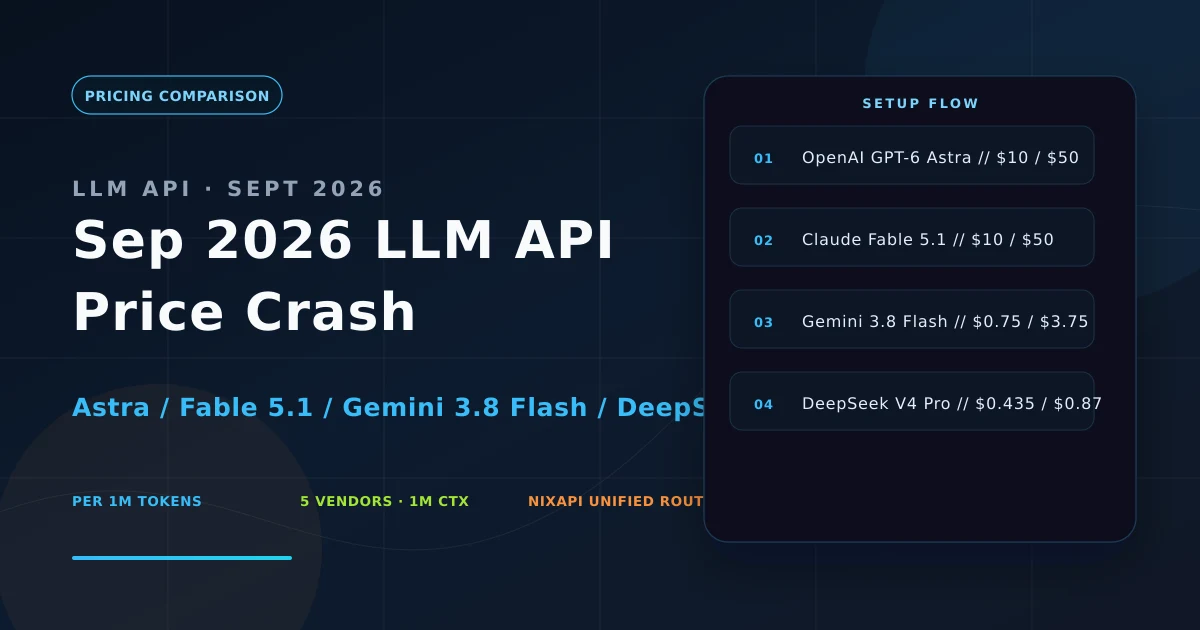
The first week of September 2026 was unprecedented for the AI industry: Anthropic Claude Fable 5.1 (Sept 1), Google Gemini 3.8 Flash (Sept 2), and OpenAI GPT-6 Astra (Sept 3) launched back-to-back, while DeepSeek completed the V4 Pro 0813 rollout in the same window and Anthropic made Sonnet 5’s promo pricing permanent. In five days, five vendors rewrote the entire LLM API price curve.
This is not a routine bump. It is “price-and-capability double competition” entering a new phase: three majors aligned on 1M context, agentic coding, and — crucially — cache pricing as the new battleground.
Here is a complete, actionable comparison table: per-million input/output, cache reads, context windows, headline benchmarks — plus the hidden cost that most release coverage misses, thinking tokens billed as output.
1. Core Price Comparison (updated Sept 8, 2026)
Prices are per 1M tokens, Standard tier, USD. Batch/Flex is usually 50% off; Fast/Priority is usually 2x.
| Model | Vendor | Input $/M | Output $/M | Cache read $/M | Context | Launch |
|---|---|---|---|---|---|---|
| GPT-6 Astra | OpenAI | $10.00 | $50.00 | $1.00 | 1.05M | 9/3 ann. · 9/4 API |
| GPT-5.6 Sol | OpenAI | $4.00 | $20.00 | $0.40 | — | reference |
| Claude Fable 5.1 | Anthropic | $10.00 | $50.00 | $0.25 | 1M | 9/1 |
| Gemini 3.8 Flash | $0.75* | $3.75* | $0.075 | 1.048M | 9/2 | |
| DeepSeek V4 Pro 0813 | DeepSeek | $0.435 | $0.87 | $0.0036 | 1M | 8/12 GA |
| Claude Sonnet 5 | Anthropic | $2.00 | $10.00 | — | 1M | pricing made permanent |
* Gemini 3.8 Flash’s $0.75/$3.75 is an introductory rate valid through Dec 31, 2026; from Jan 1, 2027 it reverts to the standard $1.50/$7.50 (input/output).
Reading the table at a glance
- Cheapest: DeepSeek V4 Pro without contest — $0.435 input / $0.87 output, an order of magnitude below GPT-6 Astra.
- Most expensive: GPT-6 Astra and Claude Fable 5.1 sit together at the top, both $10/$50.
- Best price-performance frontier: Gemini 3.8 Flash at $0.75/$3.75 — 1/13 of Astra/Fable — yet Terminal-Bench 2.1 already hits 90.8% (official).
- Hidden winner: Anthropic slashed Fable 5.1 cache reads from $1 to $0.25 (−75%), a decisive advantage for long-context agentic workloads.
2. What Each Vendor Is Really Competing On
2.1 OpenAI GPT-6 Astra: the flagship bar moves up
GPT-6 Astra was announced Sept 3 and hit the API Sept 4 as gpt-6-astra, with a 1,050,000-token context window and 128K max output.
Pricing: $10/$50 standard; cache read $1 (cache writes $12.50); prompts past 272K input tokens reprice the full request at 2x input / 1.5x output.
It is 2.5x more than GPT-5.6 Sol ($4/$20). With Claude Fable 5.1 it is now the most expensive flagship, and it is one of the first OpenAI models to bill cache writes separately at $12.50 — for long-prompt agentic tasks, cache cost is now itemized.
2.2 Claude Fable 5.1: the real “price cut” is in the cache
Fable 5.1’s headline price matches Fable 5 ($10/$50). The real move: cache reads dropped from $1 to $0.25 (−75%, a quarter of Fable 5’s rate).
Anthropic estimates ~25% lower cost on typical workloads and up to ~45% on complex/agentic ones — because agentic tasks repeatedly re-read the same persistent prefix.
For teams running long-horizon agents or batch coding, Fable 5.1 is far more cost-competitive than its sticker price suggests.
2.3 Gemini 3.8 Flash: pulling the cost-performance frontier down 13x
Google shipped a third Flash release in six weeks (3.8 Flash after 3.6/3.7), entering at $0.75/$3.75 intro pricing.
- Terminal-Bench 2.1: 90.8% (official) / 89.4% (AA independent) — approaching or beating far pricier flagships;
- DeepSWE 1.1 (long-horizon SWE): 73.7% (AA) — “outperforms most larger frontier models on autonomous end-to-end engineering”;
- HLE-Verified: 54.9% — multi-step reasoning across STEM, humanities, and professional fields.
Key caveat: thinking tokens bill as output. The API reports thoughtsTokenCount separately from candidatesTokenCount, but both bucket at $3.75. Budgets crossing Dec 31, 2026 must assume the Jan 1 rate of $1.50/$7.50.
2.4 DeepSeek V4 Pro 0813: absolute low price + peak/off-peak billing
DeepSeek V4 Pro 0813 (GA Aug 12) priced cache-miss input at $0.435 and output at $0.87, with cache hits at just $0.0036 — unarguably the lowest price among serious large models today.
Note it transitioned (Aug 16 UTC) to peak/off-peak billing: off-peak is half of peak, but even the new off-peak rates are 50%+ above the 0813 baseline. Plan long-term budgets around which hour bucket your calls land in.
2.5 Claude Sonnet 5: the promo price goes permanent
Sonnet 5’s $2/$10 was time-limited promo. Anthropic now makes it permanent — normalizing mid-tier 1M-context pricing at historical lows. It is the positioning play: 5x cheaper than Opus/Fable, aimed at “fast + cheap + good enough” daily production loads.
3. The Real Cost Gotchas: Thinking Tokens & Cache
Two details hide beneath the “price crash” narrative and trip up real bills.
3.1 Thinking tokens are billed at the output price
Gemini 3.8 Flash, GPT-6 Astra, and Claude Fable 5.1 all “think before answering.” Those thinking tokens are metered at output rates, not the cheaper input rate.
- Gemini 3.8 Flash: both thought tokens and the visible answer bill at $3.75 (output bucket);
- GPT-6 Astra / Fable 5.1: thinking tokens bill at the $50/M output rate.
Practical meaning: a cheap input price (like Flash’s $0.75) only reflects prompt ingestion; the real bill is driven by the output side. Compare models by cost per task, not price per token — e.g., Artificial Analysis measured Gemini 3.8 Flash at ~$0.58/task because it emits ~30% more output tokens, versus $0.40 for 3.7 Flash.
3.2 Cache price is the deciding factor for agentic loads
Long-context agents constantly re-read the same prefix. Cache-read rates across the five:
| Model | Cache read $/M | vs input price |
|---|---|---|
| Claude Fable 5.1 | $0.25 | 2.5% of input |
| GPT-5.6 Sol | $0.40 | 10% |
| GPT-6 Astra | $1.00 | 10% |
| Gemini 3.8 Flash | $0.075 | 10% |
| DeepSeek V4 Pro | $0.0036 | <1% |
DeepSeek’s cache-hit price is nearly free at $0.0036; Fable 5.1 undercuts everyone else on agentic loads with $0.25. Whatever the banner prices say, the more “re-read heavy” your workload (RAG, long sessions, repo-scale agents), the more cache pricing decides the winner.
4. So Which Should You Pick?
Straight answers for three common profiles:
| Your use case | Recommendation | Why |
|---|---|---|
| Ultra cost-sensitive, high-volume, retrieval-heavy | DeepSeek V4 Pro | $0.435 input / near-free cache = long-context RAG default |
| Long-horizon agentic, want frontier | Claude Fable 5.1 | $0.25 cache makes long sessions drastically cheaper |
| High performance + strong value balance | Gemini 3.8 Flash | TB2.1 90.8%, $0.75/$3.75 intro, 1M ctx |
| Daily workhorse, fast & reliable | Sonnet 5 ($2/$10 permanent) | mid-tier price halved, great default load |
| Best frontier reasoning / coding, generous budget | GPT-6 Astra | 1.05M ctx + flagship, but $10/$50 is the priciest |
5. Use a Routing Layer (NixAPI), Don’t Lock Into One Vendor
The flip side of a price crash is selection risk: Gemini 3.8 Flash is cheap today, DeepSeek’s peak/off-peak shifts tomorrow, Fable 5.1’s cache rate adjusts the day after. Marrying one vendor means handing your cost curve to someone else.
NixAPI’s value isn’t “pick a model for you” — it’s letting you reach every vendor through one OpenAI-compatible endpoint and treat the model field as a routing switch:
curl https://nixapi.com/v1/chat/completions \
  -H "Authorization: Bearer $NIXAPI_KEY" \
  -H "Content-Type: application/json" \
  -d '{
    "model": "openai/gpt-6-astra",
    "messages": [{"role": "user", "content": "Refactor this Python module and explain your reasoning."}]
  }'
To A/B any model, just change model — zero business-code changes:
- Premium on
anthropic/claude-fable-5-1/openai/gpt-6-astra - Budget on
google/gemini-3.8-flash/deepseek/deepseek-v4-pro
With aligned cache-hit billing and batch discounts, NixAPI lets you route at runtime across all five — turning a price crash into your cost advantage rather than choice anxiety.
Conclusion
In the first week of September 2026, five vendors rewrote the LLM API price map in five days:
- New flagships: GPT-6 Astra and Claude Fable 5.1 sit together at the top at $10/$50;
- Best value: Gemini 3.8 Flash brings frontier capability to 1/13 of the price at $0.75/$3.75;
- Absolute low: DeepSeek V4 Pro at $0.435/$0.87 with near-free cache;
- Mid-tier halved: Sonnet 5 pricing made permanent at $2/$10;
- Hidden variables: thinking tokens billed as output, and cache price as the agentic battleground.
The savvy approach isn’t to glue yourself to one row of the table — it’s to keep them all as runtime options behind a layer like NixAPI. In the era of 1M context, agentic coding, and a cache-price war, whoever can route freely between vendors owns the price curve.
Sources
- OpenAI GPT-6 Astra API Pricing — developers.openai.com/api/docs/pricing
- Anthropic Fable 5.1 Pricing — platform.claude.com/docs/en/about-claude/pricing
- Google Gemini 3.8 Flash Pricing & Benchmarks — ai.google.dev/gemini-api/docs/pricing
- DeepSeek V4 Pro 0813 Pricing — api-docs.deepseek.com/quick_start/pricing
- Artificial Analysis Terminal-Bench v2.1 Leaderboard — artificialanalysis.ai/evaluations/terminalbench-v2-1
- NixAPI supported models & pricing · NixAPI API docs · NixAPI console
Try NixAPI Now
Reliable LLM API relay for OpenAI, Claude, Gemini, DeepSeek, Qwen, and Grok with ¥1 = $1 top-up
Sign Up Free