Anthropic Releases Claude Sonnet 5: The Most Agentic Sonnet Yet, Performance Nears Opus 4.8
Claude Sonnet 5 launched on June 30, 2026, as Anthropic's most agentic Sonnet model. This article analyzes its benchmarks, pricing strategy, agentic capabilities, and developer integration from an engineering perspective.
Introduction
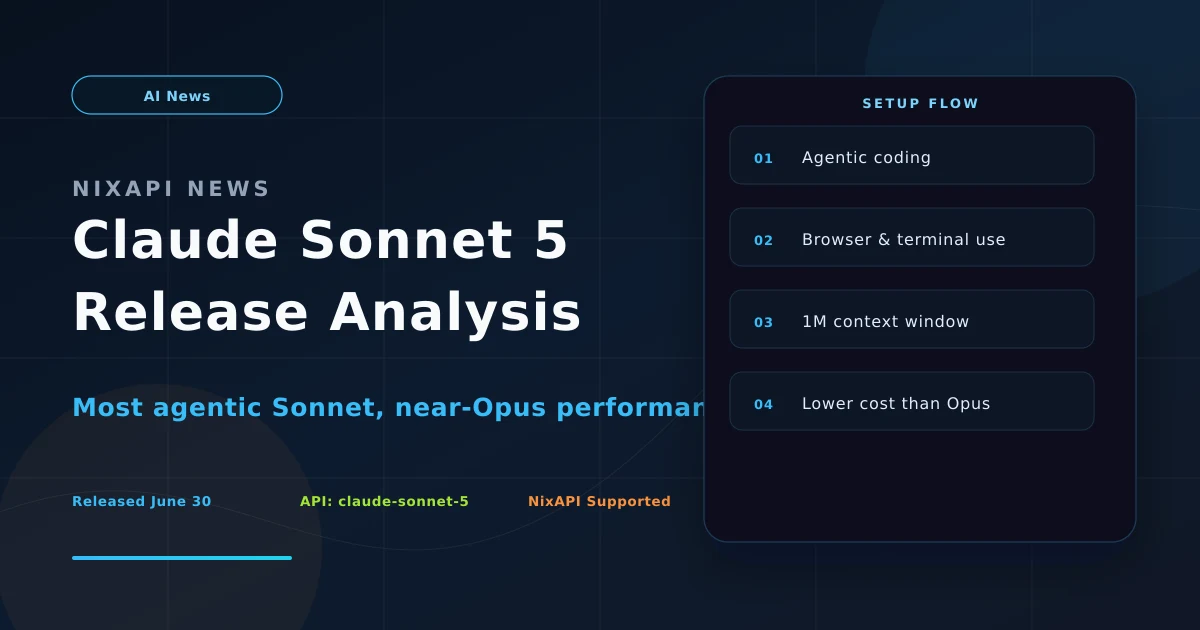
On June 30, 2026, Anthropic officially released Claude Sonnet 5 (API model ID: claude-sonnet-5). This represents the most agentic upgrade in the Sonnet lineage yet — the model can now formulate plans, operate browsers and terminals, and complete complex multi-step tasks with reduced human oversight. Most notably, its performance now nears flagship Opus 4.8 at a significantly lower cost.
For developers, Sonnet 5’s release means that in most scenarios, you may no longer need to pay Opus-level prices to achieve high-performance results.
Background: The Agentic Evolution of Sonnet
The Claude Sonnet series has always been defined by its cost-performance ratio. From Sonnet 3.5 to 4.6, Anthropic continuously balanced inference speed, tool use, and contextual understanding. With Sonnet 5, the company has clearly positioned agentic capabilities as the core differentiator for the Sonnet line.
According to Anthropic’s official blog, Sonnet 5 “can make plans, use tools like browsers and terminals, and run autonomously at a level that, just a few months ago, required larger and more expensive models”1. This positioning directly competes with Google’s agentic strategy for Gemini 3.5 Flash, launched in May2.
Core Upgrades: Performance and Agentic Ability
1. Coding and Agent Benchmarks
Sonnet 5 delivers impressive results on agentic coding tasks. Public benchmark data shows:
| Model | Agentic Coding Score |
|---|---|
| Claude Opus 4.8 | 69.2% |
| Claude Sonnet 5 | 63.2% |
| Claude Sonnet 4.6 | 58.1% |
Compared to Sonnet 4.6 (released February 2026), Sonnet 5 improves by approximately 5.1 percentage points on agentic performance; the gap to flagship Opus 4.8 has narrowed to just 6%3. For daily development workflows and moderately complex code generation tasks, this performance level is sufficient to cover the vast majority of use cases.
2. Tool Use and Autonomous Execution
The core upgrade in Sonnet 5 lies in its ability to execute multi-step agentic workflows. The model can now:
- Autonomously plan tasks: Decompose complex objectives into executable sub-steps
- Operate browsers: Open web pages, extract information, fill out forms
- Interact with terminals: Run commands, read output, and adjust next steps based on results
- Self-correct: Check intermediate results, backtrack, and fix errors when detected
The GitHub Copilot team noted in internal testing that Sonnet 5 performs particularly well on “CLI-style tasks”4 — a significant benefit for developers who rely on command-line toolchains.
3. Context Window and Output Capacity
- Context window: 1M tokens (same tier as Opus 4.8)
- Max output: 128K tokens
- Knowledge cutoff: January 2026
The 1M context window enables Sonnet 5 to process entire codebases, long documents, or extensive chat histories in a single pass — critical for code review, document analysis, and long-conversation agent scenarios.
Pricing Strategy Analysis
Sonnet 5 adopts a intro pricing + standard pricing dual-tier strategy:
| Phase | Input ($/M tokens) | Output ($/M tokens) |
|---|---|---|
| Intro pricing (until 2026-08-31) | $2 | $10 |
| Standard pricing (from 2026-09-01) | $3 | $15 |
For comparison, Opus 4.8 is priced at approximately $15/$75 per million tokens3. During the intro period, Sonnet 5’s output cost is just 13.3% of Opus 4.8; even at standard pricing, it remains only 20%.
Additionally, Anthropic offers two cost optimization mechanisms:
- Prompt Caching: Cache hits save 90% on input costs, ideal for scenarios with repeated context such as RAG and code review
- Batch Processing: Batch jobs save 50%, suitable for offline analysis, data labeling, and other non-real-time tasks
Tokenizer Change: A Migration Gotcha
Sonnet 5 uses an updated tokenizer that produces 1.0–1.35x more tokens for the same input5. Developers migrating existing applications must re-evaluate token budgets rather than simply multiplying old token counts by the new per-token price.
Safety and Reliability Improvements
Anthropic’s System Card for Sonnet 5 highlights several safety upgrades1:
- Reduced misuse cooperation: The model is less susceptible to being steered toward harmful uses
- Enhanced prompt injection resistance: Improved robustness against malicious inputs
- Lower hallucination rate: Better factual accuracy on knowledge-intensive tasks
These improvements are particularly important when deploying Sonnet 5 in production environments, especially for end-user-facing applications.
Availability and Ecosystem
Sonnet 5 was available on multiple platforms at launch:
- Claude API: Model ID is
claude-sonnet-5 - Claude Free/Pro plans: Sonnet 5 is now the default model
- AWS Bedrock, Google Cloud, Microsoft Foundry: All integrated on launch day
- GitHub Copilot: Available to Pro, Business, and Enterprise users4
This broad ecosystem coverage means developers can trial the new model without infrastructure changes — simply swap the model ID in your API calls.
Developer Integration Guide
For developers planning to adopt Sonnet 5, here are practical recommendations:
- Assess tokenizer impact: Recalculate token counts for critical use cases with the new tokenizer to avoid budget surprises
- Leverage the intro pricing window: Complete stress testing and benchmarking before August 31 to lock in lower costs
- Enable Prompt Caching: For RAG, code review, and other repeated-context scenarios, prioritize cache utilization
- Migrate from Sonnet 4.6: Simply swap the model ID — the API format remains unchanged
- Test agentic workflows: Focus validation on multi-step task success rates, which is Sonnet 5’s core strength
Conclusion
Claude Sonnet 5 marks a significant milestone in Anthropic’s pursuit of high-performance, cost-effective agentic models. With near-Opus performance, substantially lower costs, and stronger autonomous execution, it presents a compelling default model option for developers.
For the vast majority of coding, analysis, and agentic applications, Sonnet 5 is now viable as an Opus replacement — unless your use case demands that final 6% of peak accuracy. The cost advantage is especially pronounced during the intro pricing period, making early evaluation and migration a high-ROI move.
Sources:
Footnotes
Try NixAPI Now
Reliable LLM API relay for OpenAI, Claude, Gemini, DeepSeek, Qwen, and Grok with ¥1 = $1 top-up
Sign Up Free