Arcee Trinity 400B Open-Source Reasoning Model: $20M Training, Apache 2.0, and API Access Guide
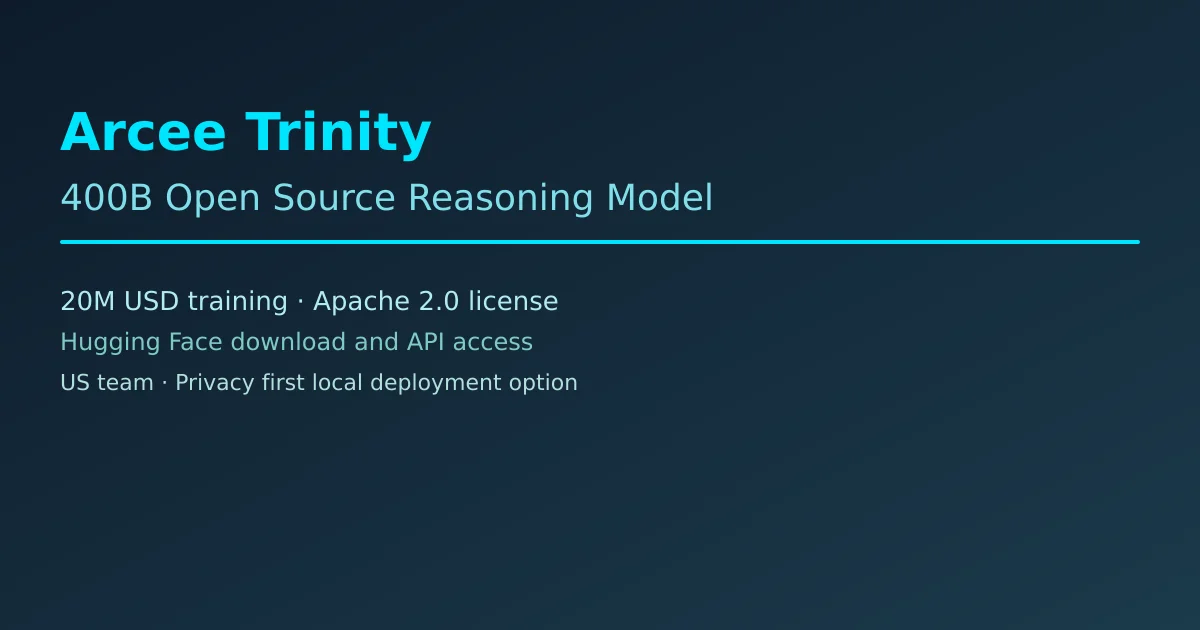
US startup Arcee trained Trinity Large Thinking, a 400B open-weight reasoning model, on a reported $20 million budget under an Apache 2.0 license. Based on TechCrunch and Let's Data Science, this article analyzes Trinity's positioning, API access paths, and how it fits into an open-source reasoning model stack alongside Llama, Qwen, Kimi, and MiniMax.
Note: All factual information comes from public reports (TechCrunch, Let’s Data Science). No speculation. All integration guidance is engineering analysis.
1. What happened: $20M for a 400B open-weight reasoning model
On April 7, 2026, Arcee — a 26-person US startup — released Trinity Large Thinking, a 400B-parameter open-weight reasoning model, trained on a reported $20 million budget under an Apache 2.0 license. Key facts from TechCrunch and Let’s Data Science:
- Scale: 400B parameters, competitive with leading open-source models on benchmarks.
- Cost: ~$20M training budget — far below typical industry estimates for this model class.
- License: Apache 2.0 — essentially unrestricted commercial use.
- Access: Available for download via Hugging Face and via API.
- Positioning: CEO Mark McQuade: “the most capable open-weight model ever released by a non-Chinese company.”
2. Why it matters for the open-source reasoning stack
Before Trinity, the open-source reasoning landscape included Llama 4 Maverick, Qwen 3.5, Kimi K2.5, GLM-5, and MiniMax M2.7. Trinity’s differentiated value:
| Dimension | Arcee Trinity | Llama 4 | Kimi K2.5 | MiniMax M2.7 |
|---|---|---|---|---|
| Parameters | 400B | ~400B | Large | Large |
| License | Apache 2.0 | Specific | Specific | Specific |
| Training cost | $20M (disclosed) | Undisclosed | Undisclosed | Undisclosed |
| API available | Yes | Yes | Yes | Yes |
| SWE-Pro | TBD | Competitive | Competitive | 56.22% |
| US team | Yes | Yes (Meta) | No | No |
Trinity’s core value proposition: a verifiable, cost-transparent, commercially clean open-weight reasoning model — ideal for enterprises that need the auditability of self-hosting without legal ambiguity.
3. API integration: two paths
Path 1: Managed API (fastest to production)
If Arcee offers a hosted API (or via Hugging Face Inference Endpoints):
// providers/arcee-trinity.ts
import { createOpenAICompatibleClient } from './base-client';

export const arceeTrinity = createOpenAICompatibleClient({
  baseURL: process.env.ARCEE_API_BASE_URL,
  apiKey: process.env.ARCEE_API_KEY,
  defaultModel: 'trinity-large-thinking',
});
Path 2: Self-hosted via vLLM (full data sovereignty)
For teams requiring complete data control:
// Local vLLM serving Trinity weights
export const arceeTrinityLocal = createOpenAICompatibleClient({
  baseURL: 'http://localhost:8000/v1',
  apiKey: '',
  defaultModel: 'trinity-large-thinking',
});
4. Routing strategy: Trinity as the privacy-first local option
export async function routeReasoningTask(task: Task) {
  if (task.requiresDataPrivacy && task.language === 'zh') {
    return models['glme-5-local'].chat(task.messages);
  }
  if (task.requiresDataPrivacy) {
    return models.local.chat(task.messages); // Arcee Trinity
  }
  return models.best.chat(task.messages); // Cloud: GPT-5 / Claude
}
5. Takeaway
Arcee Trinity proves that $20M and a focused 26-person team can produce a competitive open-weight reasoning model. For NixAPI-style gateways, Trinity is a natural candidate for the “privacy-first, commercially clean local reasoning provider” slot — filling the gap between cloud-only closed models and Chinese-origin open models for Western enterprise customers.
Try NixAPI Now
Reliable LLM API relay for OpenAI, Claude, Gemini, DeepSeek, Qwen, and Grok with ¥1 = $1 top-up
Sign Up Free