The AG-UI Protocol: Making AI Agents Truly Native to Your Application
CopilotKit raised $27M Series A and its open-source AG-UI protocol is becoming the industry standard for integrating AI Agents into application UIs. This article deep-dives into AG-UI's core design philosophy, comparison with existing approaches, practical integration examples, and why this protocol may be the missing piece for AI Native applications.
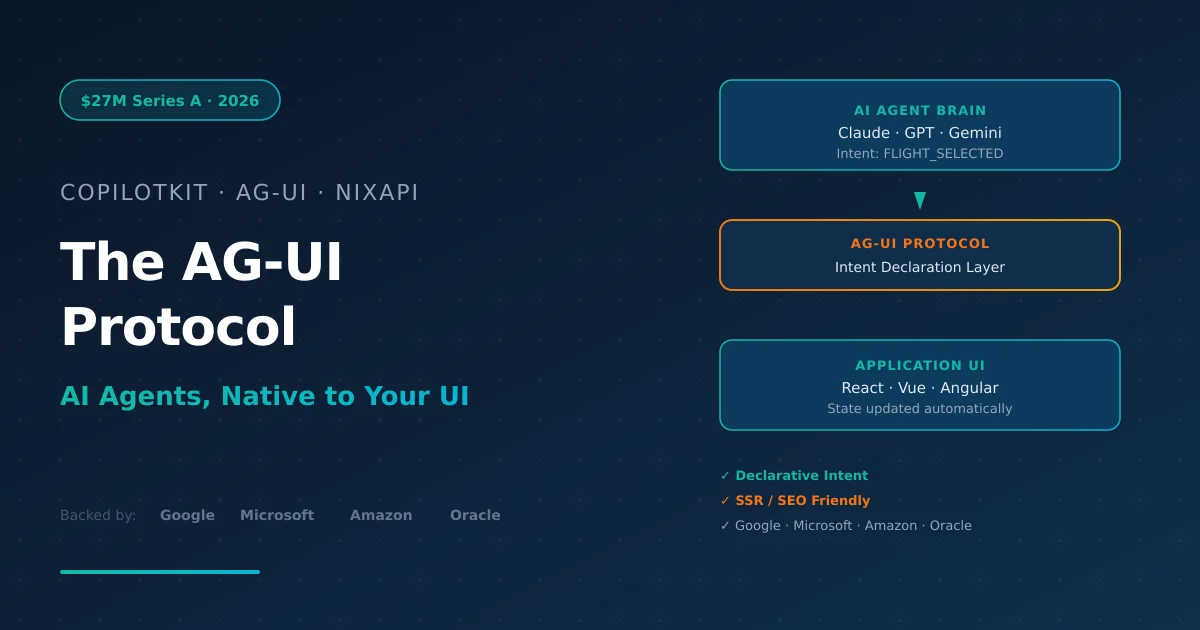
Note: Facts sourced from CopilotKit’s official announcement (copilotkit.ai, May 6, 2026) and Zamin.uz tech reporting. No undisclosed information.
1. Why a Dedicated Protocol Was Needed
The Current AI Agent “Predicament”
Today, developers integrating AI Agents with applications have three main approaches:
| Approach | How It Works | Drawbacks |
|---|---|---|
| Text-only chat | Agent returns text, app renders | Users manually copy-paste; can’t interact with real UI |
| Browser Use / Playwright | Agent controls browser to operate real pages | Slow, unstable, easy to block with anti-bot |
| Function Calling | Agent calls APIs, app executes | Each operation needs hand-written function schema; high maintenance cost |
The root issue: AI Agents output “text”, while modern applications run on “interactive UI”. There’s a semantic gap between them.
AG-UI’s Core Insight
The AG-UI (Agent-Generated User Interface) protocol’s core thesis:
An Agent should directly declare its operational intent, not simulate human UI interaction behavior.
The protocol doesn’t care about “which button to click” — it cares about “what operation to complete.” The application-layer UI framework decides how to respond to that intent.
2. How AG-UI Works
Architecture
┌─────────────────────────────────────────────────────────┐
│                    Application UI                        │
│  ┌─────────────┐  ┌─────────────┐  ┌─────────────┐      │
│  │  Component A │  │  Component B │  │  Component C │      │
│  └─────────────┘  └─────────────┘  └─────────────┘      │
│                          ↑                               │
│                    AG-UI Protocol                        │
│                    (Intent Layer)                         │
└──────────────────────────┼───────────────────────────────┘
                           ↓
┌──────────────────────────────────────────────────────────┐
│                     AI Agent                              │
│  ┌──────────────────────────────────────────────────┐    │
│  │  Agent Brain (Claude / GPT / Gemini)              │    │
│  │  → Decides intent: "user wants to book flight"   │    │
│  │  → Emits: { type: "FLIGHT_BOOKED", params: {...}}│    │
│  └──────────────────────────────────────────────────┘    │
└──────────────────────────────────────────────────────────┘
Defining Intents
AG-UI doesn’t manipulate the DOM — it declares operational intents:
// Agent side: declare intent (doesn't care about specific UI implementation)
const intent = {
  type: 'FLIGHT_SELECTED',
  params: {
    flightId: 'CA1234',
    departure: 'PEK',
    arrival: 'PVG',
    price: 890,
    passengers: 2,
  },
  confidence: 0.97,
  reasoning: 'User asked for cheapest Beijing-Shanghai flight, CA1234 is ¥890',
};

// Application side: receive and process intent
function handleAgentIntent(intent: AgentIntent) {
  switch (intent.type) {
    case 'FLIGHT_SELECTED':
      return uiStore.updateBookingForm(intent.params);
    case 'PASSENGER_ADDED':
      return uiStore.addPassenger(intent.params);
    default:
      return uiStore.showSuggestion(intent);
  }
}
Bidirectional State Synchronization
Another core AG-UI capability is bidirectional state sync:
// Application → Agent: UI state changes sync in real-time
uiStore.on('change', (state) => {
  copilotKit.syncContext({
    flightSelection: state.selectedFlights,
    passengerCount: state.passengers.length,
    totalPrice: state.totalPrice,
  });
});

// Agent → Application: intents directly drive UI changes
copilotKit.on('intent', (intent) => {
  if (intent.type === 'FLIGHT_SELECTED') {
    // Directly update UI state; framework re-renders automatically
    bookingStore.setFlight(intent.params);
  }
});
3. Comparison with Existing Approaches
| Dimension | Text-only | Browser Use | Function Calling | AG-UI |
|---|---|---|---|---|
| Response speed | Fast | Slow (5–15s) | Fast | Fast |
| Stability | High | Low (DOM-structure sensitive) | High | High |
| Maintenance cost | Low | High (breaks when DOM changes) | Medium | Low (declarative) |
| Accessibility | Low | High | Medium | High |
| Framework support | Any | Playwright | Any | React/Vue/Angular |
| AI Native |
4. CopilotKit Ecosystem Status
Supported Platforms
- Frontend frameworks: React (official), Vue (community), Angular (community)
- Backend integration: LangChain, LangGraph, AutoGen, DSPy
- Vector stores: Pinecone, Weaviate, Chroma, Atlas
Partners
Google, Microsoft, Amazon, and Oracle have all joined the CopilotKit ecosystem — signaling mainstream cloud provider backing for the AG-UI protocol.
Practical Code Example
// React app integrating AG-UI
import { CopilotKitProvider, useAgent } from '@copilotkit/react';

function BookingApp() {
  return (
    <CopilotKitProvider
      agent="flight-booking"
      guidelines={[
        'Always confirm passenger details before ticketing',
        'Require second confirmation for prices above ¥5,000',
        'Prioritize domestic flights',
      ]}
    >
      <BookingUI />
    </CopilotKitProvider>
  );
}

function BookingUI() {
  const { intent, context, suggest } = useAgent('flight-booking');

  // Listen for Agent intents to drive UI updates
  useEffect(() => {
    if (intent?.type === 'FLIGHT_SELECTED') {
      setSelectedFlight(intent.params);
    }
  }, [intent]);

  return (
    <div>
      <FlightList onSelect={(f) => suggest({ type: 'FLIGHT_SELECTED', params: f })} />
      <BookingSummary flight={selectedFlight} />
    </div>
  );
}
5. SEO Implications
Why Traditional Agent Apps Are Unfriendly to Search Engines
Most current AI Agent products (various Copilot assistants) have an overlooked problem:
- Content is rendered dynamically via JavaScript
- Search engine crawlers can’t execute JS — they can’t access the actual content
- Search rankings depend on server-side rendered (SSR) content
AG-UI’s SEO Advantage
AG-UI protocol’s declarative intent nature is naturally SEO-friendly:
- Semantic clarity: Intent types (like
PRODUCT_SELECTED,QUESTION_ASKED) are本身就是结构化数据 - SSR-friendly: Application frameworks can pre-render the Agent interaction layer server-side, without relying on JS execution
- Indexable content: Agent-generated content is injected into the page via the Intent protocol, visible to crawlers
┌──────────────────────────────────────────┐
│  Agent: "What flights are available from  │
│          Beijing to Shanghai?"            │
│  → Intent: SEARCH_FLIGHTS { from: 'PEK', to: 'PVG' } │
│  → App queries database, renders results on SSR page │
│  → Crawler can index; search-visible     │
└──────────────────────────────────────────┘
6. NixAPI Integration Value
For NixAPI multi-model API gateway users, AG-UI protocol means:
// NixAPI × AG-UI: Intent-aware multi-model routing
import { NixAPI } from '@nixapi/client';
import { CopilotKitProvider } from '@copilotkit/react';

const client = new NixAPI({
  apiKey: process.env.NIXAPI_KEY,
  routingStrategy: 'intent-aware',
});

// Route to optimal model based on Agent intent type
const response = await client.chat({
  messages,
  // Search tasks → low-cost fast models
  // Complex reasoning → Opus 4.7
  // Code generation → Claude Code
  routingHint: detectIntent(message).type,
});

export function detectIntent(message: string): Intent {
  // AG-UI intent detection
  if (message.match(/flight|hotel|book/)) return { type: 'BOOKING', model: 'fast' };
  if (message.match(/analyze|compare|report/)) return { type: 'ANALYSIS', model: 'opus' };
  return { type: 'GENERAL', model: 'balanced' };
}
7. Key Takeaways
| Dimension | Assessment |
|---|---|
| Protocol value | Upgrades AI output from “text” to “operational intent”, bridging the gap between Agents and modern UI frameworks |
| Ecosystem maturity | Backed by major cloud providers, $27M funding, major framework support ready |
| Developer adoption | Clean protocol design, low migration cost; expected to become React ecosystem standard by end of 2026 |
| SEO impact | Declarative Intents + SSR-friendly approach has positive implications for AI Native product search visibility |
For NixAPI users: Monitor CopilotKit AG-UI developments and evaluate combining multi-model routing capabilities with AG-UI intent detection — this may be the core architecture for the next generation of AI application traffic routing.